

Think about the last week your team felt genuinely productive. Not just busy — but productive. Deadlines were met. Work moved forward. People had breathing room. And by Friday, no one felt completely drained.
For most managers, that kind of week is hard to remember. The real issue isn’t that people aren’t working hard — it’s that their workdays are constantly interrupted.
According to a study by Hubstaff, the average knowledge worker works fewer than 8 hours per day and gets less than 3 hours of actual focus time. The remainder disappears into meetings, Slack messages, context switching, and interruptions that individually seem minor but accumulate into a significant loss of time. That wasted time translates into slower delivery, lower-quality work, and teams that feel exhausted after a full day.
This is the focus time crisis. And if you’re leading a team of any size, it’s probably affecting you right now.
What the Data Actually Reveals About Focus Time
- People switch tasks or get interrupted every 3–5 minutes
- After a distraction, it can take 20–25 minutes to fully refocus
- Employees spend more than 30 hours a month in meetings that don’t add much value
- On average, only 2–3 hours of an 8-hour day are spent in true deep work
The real issue is that the cost isn’t obvious right away.
No one files a report saying, “We lost 45 minutes of deep work because of a status meeting that could’ve been an email.” Instead, the impact shows up later — missed deadlines, rushed deliverables, and teams that feel exhausted even though they “worked all day.”
Meeting Overload: The Real Problem
One of the most common yet unresolved problems in today’s workplaces is meeting overload. Every manager knows there are too many meetings. Very few actually take action on it.
This isn’t about eliminating meetings. Collaboration is necessary. The question is how the meetings are arranged in connection with the rest of the day. Three 30-minute meetings scattered across the day don’t just waste 90 minutes. In between, employees are unable to do any sustained work. That 40-minute gap before an 11 a.m. call isn’t real focus time — it’s just waiting time.
Focus takes time to build. Most people need 20–30 minutes before they’re fully immersed in meaningful work. When meetings are scattered, you never get that ramp-up time back. People end up operating at a shallow level.
The Unseen Price of Quick Check-Ins
Even a 10-minute check-in can be surprisingly disruptive to productivity. It may seem harmless; after all, how could anything disrupt productivity in just 10 minutes? However, a 10-minute meeting at 10:50 a.m. does not only cost 10 minutes. It disrupts the entire productive block between 10 and 11, because no one can focus on serious work while knowing they must leave for a meeting in 20 minutes.
Repeat that pattern across a workforce of 10 people, and a large portion of your team’s work capacity is silently consumed by unnecessary meetings that don’t need to exist in their current form.
Why Deep Work Is Different
The work of Cal Newport on deep work makes a clear distinction between two categories of professional activity: deep work (cognitively demanding work done in a state of undivided, distraction-free concentration) and shallow work (reactive, logistical work that does not add significant mental load). Poor workplace design pushes most teams toward shallow work.
According to Cal Newport, deep work requires two rare conditions in modern workplaces: cognitive intensity and a distraction-free environment. And both are constantly under pressure.
Multitasking weakens true focus. Neither task gets your full attention. When developers write code while constantly checking Slack, the code ends up with bugs. At the same time, the Slack response may also miss an important detail. Quality declines on a universal level.
A distraction-free environment disappears in cultures built around constant communication and open-door policies, where constant availability has become the default expectation.
This creates a real challenge for managers. Teams are expected to stay responsive while also producing high-quality work. These two needs often conflict with each other, and in most workplace cultures, responsiveness has quietly been prioritized over actual production.
Time Tracking: A Diagnostic Tool, Not Surveillance
Before we go further, let’s address something directly. Time tracking has an image issue.
To most managers and employees, the word itself evokes images of micromanagement, screenshots every few minutes, minute-by-minute responsibility, and the technological version of having someone over your shoulder. That version of tracking exists — and it’s counterproductive. It destroys trust, increases anxiety, and rarely improves performance.
However, that is not the only way time tracking can be used. Time tracking, when used properly, is like a blood pressure monitor — a diagnostic tool. It doesn’t control you. It shows you what’s actually happening so you can make better decisions.
What Good Focus Time Data Tells
When you analyze how your team actually spends time — rather than how they think they spend it — you are likely to discover uncomfortable truths:
- The percentage of meetings that swallow up a week is much greater than anyone thought.
- Some of the team members are over-pulled in meetings as compared to others.
- Your team’s focus hours are not being safeguarded but are instead overloaded with interruptions.
- Well-resourced projects are, in fact, receiving far fewer deep-work hours than originally budgeted.
When you see the data clearly, the conversation changes. Rather than arguing about whether individuals are working hard enough, you will now be able to begin posing the right question: Are we building the conditions under which great work can be done?
How Teams Can Find and Protect Focus Time with WebWork
Tools like WebWork Time Tracker were designed with this problem in mind. Instead of treating time data as an accountability tool, WebWork’s time tracking provides managers and team members with the visibility they need to protect focus time and make better decisions.
Focus Time Reports
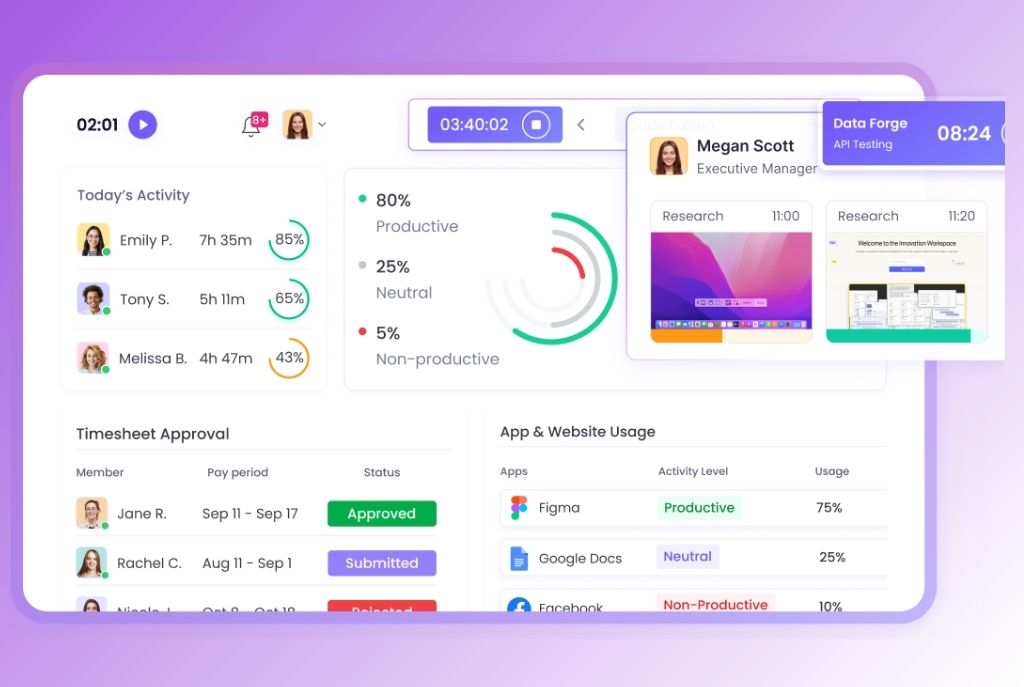
WebWork’s time reports break down team hours into focus work, communication, administration, and task-switching. It is not a performance review; it is a roadmap of how the day is really going. For managers, it reveals patterns that would otherwise remain invisible: which days are consumed by reactive work, which team members have virtually no protected time, and where the largest opportunities to reclaim focus exist.
Productivity Scoring and Activity Timelines
WebWork’s productivity scoring also helps people understand their personal work habits, when they are the most productive, what kinds of tasks they achieve well, and where time is lost. The activity timeline provides an hour-by-hour view of how the day actually unfolded — which is often very different from how people remember it.
Together, these features replace assumptions with clear, actionable data. That evidence is what enables real structural change, as opposed to empty promises of meeting less often, which, in reality, never materialize.
Before and After: Real Teams, Real Results

A Remote Marketing Team
A 12-person marketing team was consistently missing deadlines despite everyone logging full hours. Morale was poor. After one month of tracking with WebWork, the picture became clear.
Average focus time per person: 2.1 hours per day. The team was averaging 4.2 meetings per day per person, and their most productive window — Tuesday and Wednesday mornings between 9–11 a.m. — was being blocked by a standing all-hands status meeting.
The fix was straightforward once the data made it visible. The status meeting was moved to Thursday afternoon. Tuesday and Wednesday mornings became protected, meeting-free blocks. WebWork’s weekly reports were used to hold that boundary week to week.
After 60 days, average focus time rose to 4.4 hours per day. The team shipped a major campaign two weeks ahead of schedule. Three team members reported it was the first time in over a year they felt like they were actually doing their jobs.
A Software Development Team
A development team was shipping slowly and accumulating bugs. Their manager couldn’t find the bottleneck — everyone seemed engaged and busy all day.
WebWork’s data revealed the issue: developers were being interrupted by an average of 6.7 short meetings per day, many lasting less than 15 minutes. Each one fragmented the sustained concentration at work that writing good code requires.
The team introduced a simple rule: no meetings before noon for engineers, with async updates replacing most of the short check-ins. Within six weeks, daily focus time improved from 2.3 to 5.1 hours per person. Production bug rates dropped by 40%.
Six Ways to Protect Your Team’s Focus Time
None of this requires a culture overhaul. It requires deliberate choices and the willingness to treat focus time as a resource that shouldn’t be compromised.
Begin With an Honest Time Audit
Two weeks before altering anything, trace the actual spending of your team’s hours. Use WebWork or a similar tool. The majority of managers are really surprised by their discovery. You can’t protect focus time if you can’t see it.
Create Meeting-Free Focus Blocks
Establish protected focus blocks, at least 2 hours per day, ideally in the morning when one is most likely to be focused. Block them on the calendar as recurring events. Treat them like client meetings: they stay on the calendar and aren’t moved.
Audit All Recurring Meetings
Consider all standing meetings on the team calendar and ask yourself an honest question: What would happen if we canceled this? Numerous habitual meetings are not based on a need. If the answer is “we’d just post an update in Slack,” cancel the meeting.
Stop Rewarding Instant Responses
An always-on communication culture is usually motivated by a management imperative rather than by pressing necessity. When your team believes that they have to reply to every message in a few minutes, that pressure will break their focus at the workplace, no matter how many blocks without meetings you make. Establish specific norms of response time and model them.
Make the case upward by using data.
Focus time tracking gives you the evidence to push back on unnecessary meetings and time fragmentation. Saying ‘we need fewer meetings’ sounds like an opinion. The data shows our team averages just 2.3 hours of dedicated work per day, which explains why delivery is slow.
Schedule your most difficult work during your team’s most productive hours.
When you have data on focus time, you will begin to know when your team is actually at its best, not merely busy, but actually thinking as well. Protect those windows strictly. Don’t schedule meetings in those windows unless it’s truly urgent and cannot be postponed.
The Long-Term Cost of Ignoring This Problem
It’s easy to ignore focus time when you’re busy putting out daily fires. Research shows the opposite.
Work teams that guard deep work productivity not only feel improved, but they also work more quickly, come up with superior-quality work, and keep individuals longer. One of the most reliable results in organizational research is the association between the maintained level of focus and quality of output.
In the meantime, meetings that get permanently overbooked and interrupted every moment are not merely less effective. They quietly wear people down. One of the biggest drivers of burnout is the always-on culture — and it comes at a real cost. Rehiring, loss of institutional knowledge, and eventual loss of faith in the possibility of good work on the part of a team.
Your team has the talent. The real question is whether you’re giving them the right conditions to use it.
Where to Start
If you’re serious about giving your team back their focus time, start with data. Not assumptions, not gut feelings — actual data about how your days are being spent.
WebWork makes this straightforward. Set it up, let it run for a few weeks, and then look honestly at what the numbers tell you. You’ll almost certainly be surprised by what the data reveals. Most teams are.
From there, it’s about making decisions — protecting certain hours, restructuring or cancelling meetings, creating clear norms around communication and availability. None of it is complicated. But it does require treating focus time as the strategic asset it actually is, not an afterthought.
Your team has the talent. They just need the space to use it.