

You recall that the term ‘catfishing’ was once relegated to the world of online dating sites — and now it’s invading the business world — bringing ‘ghost employees’ into your workforce and disrupting hiring processes. This isn’t science fiction — it’s already happening.
It goes far beyond simple resume padding.
Today, companies are facing a new reality. Gartner predicts that 25% of job applicant profiles could be fake by 2028 — and early signs show that this shift has already begun. In this new reality, AI is helping create fake job candidates at scale. The rise of fake job candidates AI is rapidly changing how companies approach hiring, especially in remote environments.
It’s no longer just about resume padding.
Instead, this is a new world shaped by fake job candidates AI, making it more difficult than ever to find the real deal.
Remote Hiring Removed Every Natural Friction Point
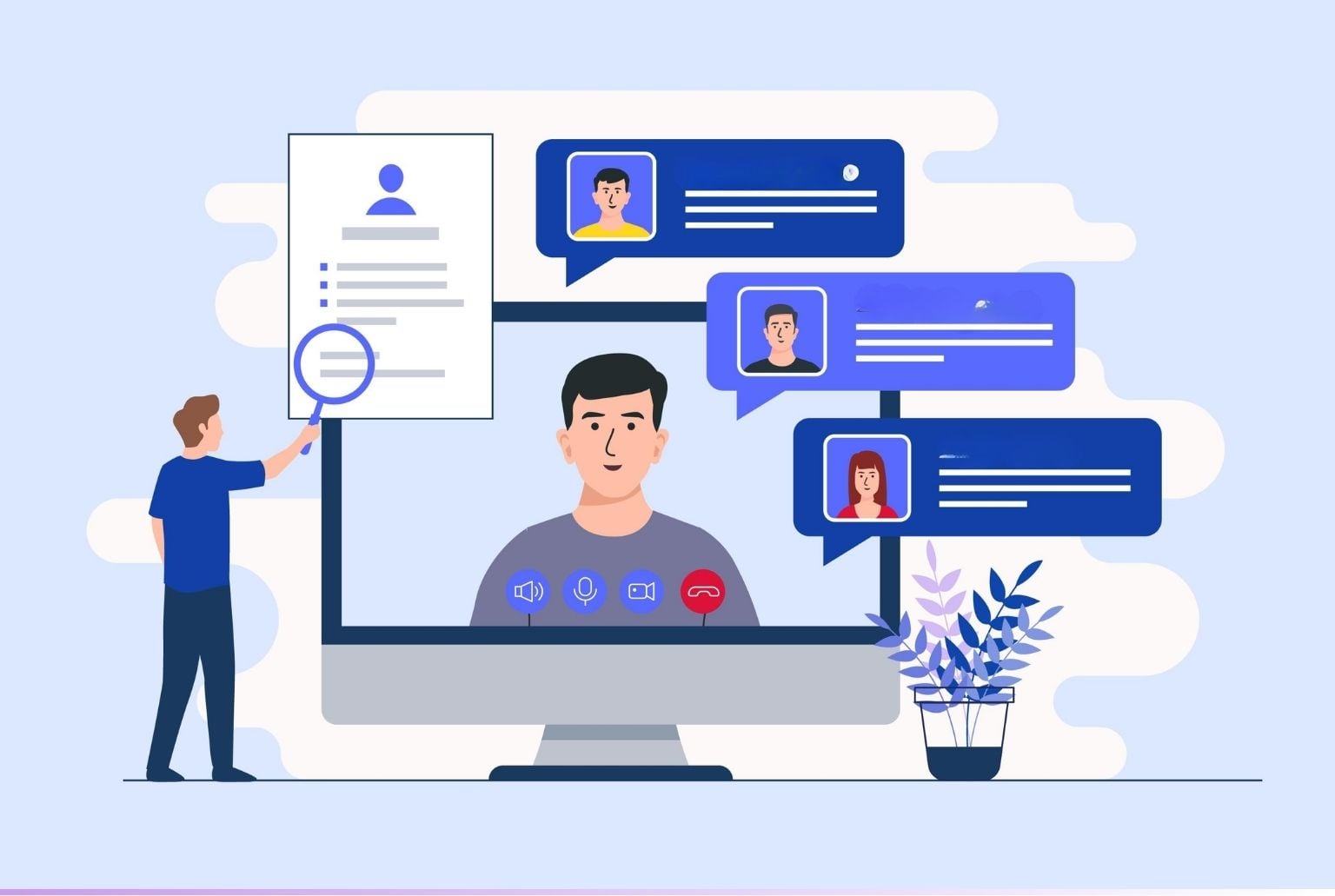
For most of corporate history, employment fraud had physical limitations. You’d meet people in person. You’d observe how they worked on a whiteboard as you presented a problem. You’d dial a phone to call references — and collectively, these steps made it extremely difficult to impersonate someone else at scale.
However, remote hiring has erased most of these obstacles in just a few years. You can now hire someone you’ve never shared physical space with, verified only by a video call and documents they provide. This creates a major vulnerability — and AI is already exploiting it. This environment makes it easier than ever for fake job candidates AI systems to exploit hiring gaps.
Here’s what the actual fraud landscape looks like in 2025:
Resume Fraud: Artificially generated resumes, crafted to perfectly match the requirements listed in the job description in a matter of seconds. These resumes include false work histories, fabricated metrics such as “improved deployment time by 38%” and formatting optimized to outsmart your ATS before a human ever lays eyes on them. This is why AI generated resumes hiring pipelines are becoming increasingly unreliable for initial screening.
Interview Fraud: Real-time interview assistance via AI. Candidates feed questions into a language model and receive the answers in real time via an earpiece or on a second monitor. In some cases, you may be interacting with AI in real time without realizing it.
Identity Fraud: Deepfake video interviews where the person on the screen isn’t even the person applying. They might be a synthetic model created using stock footage. In some cases, there may not be a real human involved at all.
Ghost Employees: A legitimate employee is hired, and right after that, the job is outsourced to someone else at a lower cost. They receive your full salary while enjoying the arbitrage profit and controlling the work remotely. This is one of the strongest use cases for fake employee detection in remote teams.
Nation-State Operations: North Korean IT worker schemes that became big news worldwide in 2024-2025, where organized groups of operatives posed as highly skilled remote software developers at hundreds of organizations in the US and Europe.
When Hiring Fraud Becomes a National Security Issue

The North Korean IT worker operations deserve special attention because they revealed the industrial infrastructure behind what most companies assumed was an individual-level problem.
Organized groups ran these operations using stolen American identities and advanced deepfake tools.
They also maintained LinkedIn profiles for months or years to appear legitimate.
They operated from so-called “laptop farms” — rooms filled with computers — where local collaborators in countries like China and Russia generated consistent activity signals during US business hours while the actual workers operated from elsewhere.
Case Study: The U.S. Department of Justice has charged several individuals linked to various schemes to hire North Korean IT workers at more than 300 American companies. One laptop farm operator controlled 60+ devices from one apartment, sending more than $1.7M directly to a foreign weapons program.
While most hiring fraud is not this advanced, these cases clearly show that organized networks have built infrastructure for large-scale remote hiring deception, and lower-level bad actors will quickly adopt these proven methods. The tools of state-sponsored fraud are now available to anyone with a laptop and enough motive.
That Resume You’re Reading? It Might Not Have Existed 10 Minutes Ago

Let’s look specifically at AI generated resumes hiring teams are now dealing with, because this is where most companies first encounter the problem — and where they consistently underestimate its scale.
The biggest risk with AI generated resumes for hiring is that these resumes are designed to pass filters, not prove real-world skills. Companies relying heavily on AI generated resumes for hiring often miss critical authenticity checks. The AI resume builders we have now don’t just fix grammar. They write. You feed in a rough draft of your work history, along with a description of a job you’re applying for, and within seconds, you have a document complete with industry-specific accomplishments, believable project names, metrics, and vocabulary. It looks as though it were crafted by a seasoned professional with just the background you’re looking for.
These AI-generated resumes are optimized to pass applicant tracking systems (ATS). Such systems look for specific keywords and patterns. It writes to outsmart those filters first and then the human recruiter’s eyes second. By the time a human recruiter reviews it, the system has already pushed it through three levels of screening, making it look completely legitimate.
Standard background checks catch verifiable fraud — whether the listed companies actually existed, for instance. But no background check can detect AI-generated accomplishments at positions that technically existed but were embellished by 400%. That gap is where fake job candidates AI tools operate with near-zero friction.
Your Interviewer May Be Talking to a Language Model on a Slight Delay
Combined with fake job candidates AI, this makes interview fraud significantly harder to detect in real time. This is the part that hiring managers find hardest to accept, but the evidence is growing too loud to ignore: a significant and rising percentage of candidates who “perform well” in remote technical interviews are using AI assistance in real time.
At the lower end, using AI in a second tab for minor assistance is debatable. The high end is clearly deceptive: wearing an earpiece that reads AI responses aloud, or using screen overlays invisible to interviewers that display live-generated answers in the candidate’s field of view. Multiple commercial tools now market themselves explicitly for this purpose. They transcribe your questions, send them to a large language model, and return formatted, confident answers within seconds.
The Fraud That Doesn’t Start Until Day One

For example, the most common post-hire scam is ghost employees. You get hired, and then right away, the person delegates their work to an underpaid freelancer from a site like Upwork or Fiverr. They attend meetings, respond to messages, and pass performance reviews by doing the bare minimum.
You get your full-time salary and keep the difference between what you pay them and what their subcontractor is willing to work for. This can go on indefinitely in a fully remote work environment where you never physically verify who is typing what. Months. Sometimes over a year. Until something like a security breach, client complaint, or overcurious manager pulls on the right thread, and suddenly the whole narrative of this amazing employee falls apart.
Your onboarding checklist, 90-day review, and quarterly OKR process don’t catch candidates who ace interviews but outsource their work. You need a new verification layer—focused on fake employee detection from day one. Without strong fake employee detection systems, companies often fail to identify fraud until months later.
WebWork: The Post-Hire Verification Layer You’re Missing
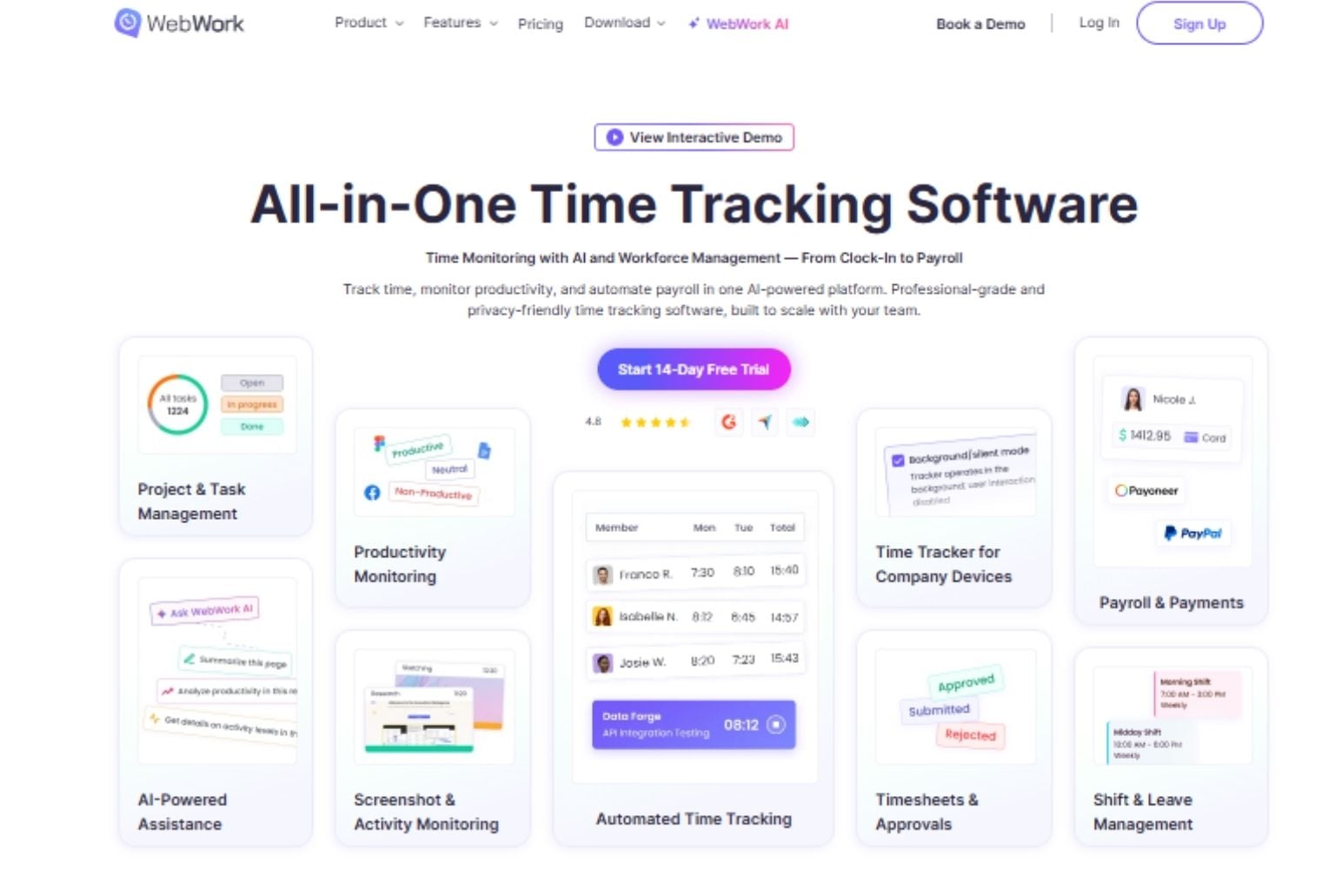
WebWork is not a surveillance tool — it acts as a dedicated post-hire verification layer. It answers the only question that actually matters after hiring: is the employee actually doing the work? The problem is no longer just hiring the right candidate — it’s verifying that they can actually do the work after they join.
When someone aces your interview, but their on-the-job behavior tells a completely different story, WebWork surfaces that disconnect within the first week, not after a quarter of missed deliverables, not after a client complaint. Within days of them starting. In most cases, WebWork helps detect ghost employees and outsourced work within the very first week.
Screenshot Monitoring: Periodic screenshots show exactly what’s on screen during work hours — exposing outsourced sessions or staged setups immediately.
Activity Levels: Keyboard and mouse activity scoring separates genuine work from a session designed to look occupied, in real time.
App & URL Tracking: A developer who never opens an IDE, a designer who never touches Figma — app usage data flags this anomaly within 48 hours of start.
Time Per Task: Tasks completed impossibly fast or dragging forever with no progress both signal that something is wrong. Real work has a recognizable time signature.
The data WebWork generates isn’t about watching employees for its own sake. It’s about pattern recognition. A genuine senior developer has a recognizable behavioral fingerprint — the tools they use, the rhythm of their sessions, the time they spend in code review vs. active development. A ghost employee or subcontracted hire has a completely different pattern. WebWork makes that difference visible immediately, before you’ve lost another sprint cycle to someone who was never really there. WebWork combines powerful features like employee monitoring software, a time tracker with screenshots, and complete remote employee monitoring to give companies real visibility into employee performance.
What a Fraudulent Hire Looks Like in WebWork — Week One
You don’t need months of data to identify a ghost employee or a subcontracted hire. The behavioral pattern appears fast. Here’s what effective fake employee detection looks like when you have the right signals:
| Signal | Legitimate Hire | Ghost / Fraudulent Employee |
| Activity pattern | Natural active/idle cycles with human variation | Unusually flat or scripted; no organic rhythm |
| App usage | Role-specific tools dominate the session | Generic tools only; critical software barely opens |
| Screenshots | Match stated work — project files, relevant code | Unrelated content, staged setups, different person |
| Time per task | Reasonable allocation matching estimates | Suspiciously fast or dragging with zero output |
| Login patterns | Consistent device, timezone, schedule | Multiple devices, shifting locations, odd hours |
Closing the Gaps That AI Fraud Exploits
You cannot solve a 2025 problem with a 2018 hiring process. Here’s the way to build a fraud-resistant approach throughout the entire process.
Before the interview: Use asynchronous recorded skill assessments where the candidate must complete live, unassisted work. This means the candidate must submit the work via screen recording with the camera turned on. A 90-minute real-world task is much more difficult to fake than a resume or interview answer. Combined with fake job candidates AI, interview fraud becomes even harder to detect in real time.
During the interview, create interview questions that focus on the candidate’s actual thought process, not just the answer. Ask the candidate to describe their thought process in coming to the answer, or ask about times they’ve failed. A computer can be taught to get the correct answer, but it cannot be taught to describe the lived experience of having actually solved this type of problem before.
At onboarding: Make clear from day one that your company usesemployee monitoring software as standard practice. Legitimate hires won’t flinch. Fraudulent ones sometimes quietly withdraw at this stage, which is a perfectly acceptable outcome.
During the first 30 days: This is where WebWork delivers the most value. Withremote employee monitoring active from day one, you won’t be waiting 90 days for a performance review to surface what the activity data would have told you in week two.
Hiring Is Step One. Verification Is the Actual Job.

When Gartner talks about how a quarter or so of applicant profiles will be fabricated in some significant way by 2028, they’re not talking about some kind of dystopian future. They’re talking about a future that’s already beginning. The technology to make these frauds happen is already inexpensive, ubiquitous, and improving faster than most hiring processes can keep up with.
We’ve spent decades perfecting the art of hiring through better job descriptions, better applicant tracking systems, and more sophisticated interviewing. Almost nothing has been spent on verification. This made sense when everyone worked in offices, and you could look across the room and know for sure that everyone there was actually working. It doesn’t make sense anymore.
Remote work is here to stay for a significant portion of the knowledge workforce. At the same time, AI-assisted fraud is only getting more advanced and more affordable. This creates a growing challenge for companies that rely heavily on remote hiring.
The solution is not to force employees back into the office or treat every new hire as a suspect. Instead, companies need to build verification directly into their hiring processes using the right tools, clear policies, and reliable data they can act on.
From fake job candidates AI to AI generated resumes in hiring, along with the increasing need for fake employee detection, the hiring landscape is undergoing a massive shift.
WebWork’s time tracker with screenshots gives you that data from day one. Whether someone is genuinely excellent at their job or just excellent at getting it, you’ll know the difference within a week. That’s not surveillance. That’s just running a business that can tell the difference between an employee and a very expensive impersonator. If you’re hiring remotely, adding a verification layer like WebWork is no longer optional — it’s essential to protect your business from modern hiring fraud.