Dubai calls it a Workforce Productivity Measurement System. Mexico’s labor code calls it an electronic record of the working day. Hubstaff’s homepage calls it workforce intelligence. Under each name sits the same object: a record of work time, read by software and turned into a management decision. That is the headline among the time tracking trends for 2027.
For most of its life the timesheet ended at payroll. In 2026 governments wrote it into law and into performance systems, banks used it to check who was at their desk, and the largest technology companies tried to score employees on it and then backed off. The eight trends below come from those events, from the 32,000+ businesses that run WebWork Time Tracker in 165 countries, and from what I expect to see next. Where a WebWork release answers a trend, I say so. Where the evidence cuts against my own industry, I say that too.
The eight time tracking trends for 2027
- Governments turn productivity measurement into an institution
- Working-time records become a legal obligation
- Targets replace activity as the unit of measurement
- Benchmarks go by job title
- AI use becomes something you measure
- Location returns as a data point
- The law separates measuring the work from watching the person
- The buyer still types “time tracking”
1. Governments turn productivity measurement into an institution
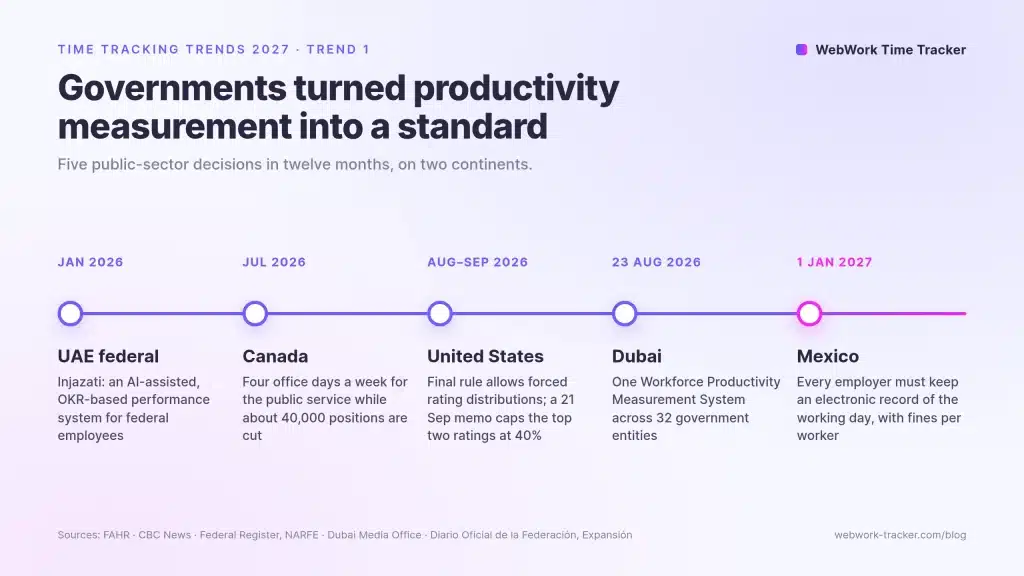
On 23 August 2026 Dubai’s Government Human Resources Department put 32 government entities on a single Workforce Productivity Measurement System, under Executive Council Resolution No. 67 of 2025. The platform runs machine learning over what the Dubai Media Office called “millions of data points” and measures the relationship between people, budgets and the services each entity delivers. The pilot started in 2020. Six years from pilot to standard.
Dubai has company. The UAE federal government moved its employees onto Injazati, an AI-assisted performance system built on OKRs and KPIs, from 1 January 2026. In the United States, the Office of Personnel Management’s rule of 7 July 2026, in force since 6 August, lifted the ban on forced rating distributions, and OPM’s memo of 21 September caps the top two rating levels at 40% of staff. Canada’s federal public service went to four days on site from 6 July 2026 while cutting about 40,000 positions. I cite these as market signals, not as customer stories.
| Government | Date | Measurement move |
|---|---|---|
| Dubai | 23 Aug 2026 | One productivity measurement system across 32 entities; outputs against people and budget |
| UAE federal | 1 Jan 2026 | Injazati, an OKR-based performance system for federal employees |
| United States | 6 Aug and 21 Sep 2026 | Final rule allows forced rating distributions; OPM memo caps the top two ratings at 40% |
| Canada | 6 Jul 2026 | Four office days a week; about 40,000 positions cut |
| Mexico | 1 Jan 2027 | Electronic record of the working day for every employer |
When a government standardizes measurement, every supplier, contractor and agency that works with it inherits the vocabulary, and procurement follows. The public sector used to be the last buyer of time tracking software. In 2027 it is the one writing the specification. Tracking at that scale is a different job from a ten-person timer, which is why enterprise time tracking is a separate page on our site and a separate conversation in our demos.
2. Working-time records become a legal obligation
Of the time tracking trends for 2027, this one has a date. Mexico published the decree cutting the working week from 48 to 40 hours in the Diario Oficial on 1 May 2026. Inside it sits a smaller clause with a larger operational effect. A new fraction XXXIV of Article 132 of the Federal Labor Law obliges every employer to record the working day electronically, entry and exit, and hand the record to the authority on request. The obligation takes effect on 1 January 2027, with fines of 250 to 5,000 UMA per worker, and the technical rules from the labor ministry were still pending in October. Every HR team in Mexico is choosing a time tracking system this quarter, whether it planned to or not.
Europe got there earlier. The Court of Justice of the EU ruled in May 2019 that member states must require an “objective, reliable and accessible” system to record each worker’s daily working time, and Spain made daily records mandatory the same month. By 2027 the boardroom question in Madrid or Mexico City is whether the record would survive an inspection.
The WebWork answer is the Worked vs Expected report, shipped on 30 July 2026: contracted hours against tracked hours, per person and per day, with the gap visible before an inspector asks. It lives inside attendance monitoring rather than in a second system bought for the auditor. A compliance record that comes out of the same data the team already works with is the cheapest compliance there is.
3. Targets replace activity as the unit of measurement
The AI leaderboards of 2026 were a live experiment in measuring the wrong thing. A Meta employee built a leaderboard ranking the top 250 token users among the company’s 85,000 staff; it came down two days after The Information reported it, Fortune wrote on 9 April. Amazon set a target of more than 80% of its developers using AI tools every week, watched the numbers inflate, and shut its KiroRank leaderboard in May. By September Meta told engineers that token counts would play no part in evaluating impact. SHRM’s conclusion on 9 June: when companies measure activity instead of business outcomes, employees optimize for the metric rather than the result.
Dubai’s system measures outputs against people and money at entity level. Nothing in the announcement is keystroke-level. That is the direction for 2027: a target per metric, a result against it, and the activity data underneath as evidence rather than as the score.
We built Productivity KPIs, released 11 September 2026, on that logic. A manager sets a target for a metric at workspace, team or job-title level, and each member shows as met or not met inside productivity insights. Which metrics deserve a target is a longer piece; the short list is in our guide to employee productivity metrics. Our own data explains why the target matters more than the raw number: across WebWork workspaces about 19.3% of tracked time is inactive. Without a target per role that figure is a mood. With one it is a decision.
4. Benchmarks go by job title
Microsoft’s 2025 Work Trend Index found 53% of leaders saying productivity must rise, while 80% of the workforce said they lack the time or energy to do their jobs. Part of that gap is a measurement artifact. A company-wide average compares a designer with a support agent and tells neither of them anything.
Measurement in 2027 is relative to the role. Gartner calls the discipline workstyle analytics, the HR suites are adding role-based baselines, and buyers looking for workforce analytics software are asking for comparisons that make sense to the person being compared. At WebWork, Insights by Job Title, released 25 September 2026, compares a person’s focus time, meeting time and application mix with others in the same role in the same workspace. The average WebWork user touches 8.68 applications a day. Whether that is focus or fragmentation depends entirely on the job.
See the measurement layer on your own team
A WebWork demo walks through worked vs expected hours, productivity KPIs and job-title benchmarks, set up for your team size and the level of visibility you choose.
5. AI use becomes something you measure
Two things happened at once in 2026. AI became a category of work time to be tracked, and AI became the thing doing the tracking. On 23 April 2026 the UAE set a target of moving half of government services to agentic AI within two years, with ministers and directors general assessed on it. Microsoft built Copilot Analytics to measure Copilot adoption and business impact. The leaderboards in trend three were the crude version of the same instinct.
On the tracking side, WebWork’s AI Usage and Distraction tracking, released 28 August 2026, reports which AI tools a team uses, for how long and what share of the day they take, next to the application-switching data that shows the cost of fragmentation. WebWork AI Schedules then deliver that as a report on a timetable rather than as a dashboard someone has to remember to open; the same engine runs our AI-powered monitoring. Teams used to spend five to seven hours a week compiling time reports by hand. In 2027 the system writes the report and the manager spends those hours on the question it raises.
6. Location returns as a data point
Return-to-office policy made location measurable again. In March 2026 JPMorgan piloted a system that checks junior bankers’ timesheets against video calls, desktop activity and calendars, “about awareness, not enforcement” in the bank’s words. The US Government Accountability Office found the Department of Transportation’s largest buildings at 34% utilization in 2025. Gartner put the share of digitally monitored employees at 71%, up 30% in a year. Hybrid policies now name a number of days, and someone has to count them.
The measurement that follows is dull and useful: where the work was done, against where it was supposed to be done. WebWork added actual versus assigned work location on 25 September 2026, beside real-time alerts for non-productive use, because the hybrid teams we serve asked for a fact rather than a badge report. A location record is a fact about the work. The next trend explains why keeping it that way is about to matter legally.
7. The law separates measuring the work from watching the person
Of the eight time tracking trends, this is the one a legal team reads first. While governments standardize measurement of output, legislators are fencing in monitoring of the person. The EU AI Act has banned emotion recognition in workplaces since 2 February 2025. On 17 December 2025 the European Parliament voted 451 to 45 for rules barring the processing of workers’ emotional or psychological states, private communications and off-duty data. The UK consulted on workplace monitoring technologies from July to September 2026, including a duty to consult unions first. In the US, Maine’s LD 61 bans audiovisual monitoring in employees’ homes, Connecticut’s expanded notice law took effect on 1 October 2026, and California’s SB 947, signed 30 September 2026 and effective 1 July 2027, bars discipline based solely on an automated system.
The evidence sides with the legislators. A 2023 meta-analysis of 94 samples found no evidence that electronic performance monitoring improves performance. The American Psychological Association found 56% of monitored workers feel tense or stressed at work, against about 40% of those who are not monitored. HBR, 17 September 2026: “Cheap monitoring does not make the costs of control vanish—it only makes them easier to ignore.” France’s Conseil d’État drew the line in December 2025 when it halved Amazon’s €32 million fine: the warehouse’s real-time productivity indicators were lawful, keeping the resulting data on every worker for 31 days was not.
This is the line WebWork has held since 2016. Screenshots can be on, blurred or off. Each team decides how much of its activity data it wants to see, and our productivity monitoring runs on that setting rather than on a vendor default. The buyer in 2027 wants the measurement and wants to pass the audit, and the tools that last are the ones that let a company choose.
8. The buyer still types “time tracking”
Around us, the category renamed itself.
| Vendor | Homepage headline, October 2026 |
|---|---|
| ActivTrak | Track AI impact. Optimize how work gets done. |
| Hubstaff | More than time tracking. Meet workforce intelligence. |
| Time Doctor | Workforce visibility for distributed teams |
| Insightful | Work Insights to Drive Bottom Line Efficiency |
| Teramind | User activity. Insider risk. One platform. |
| Prodoscore | Better workforce decisions start with knowing how work actually gets done |
| WebWork | AI-Powered Time Tracking Software |
The buyer did not follow. In WebWork’s Search Console over the 90 days to 7 October 2026, queries containing “time tracking” produced 86,000 impressions. Queries containing “workforce analytics” produced 3,700. “Work intelligence” produced 11, all from one question. People search for the thing they know and buy the measurement inside it.
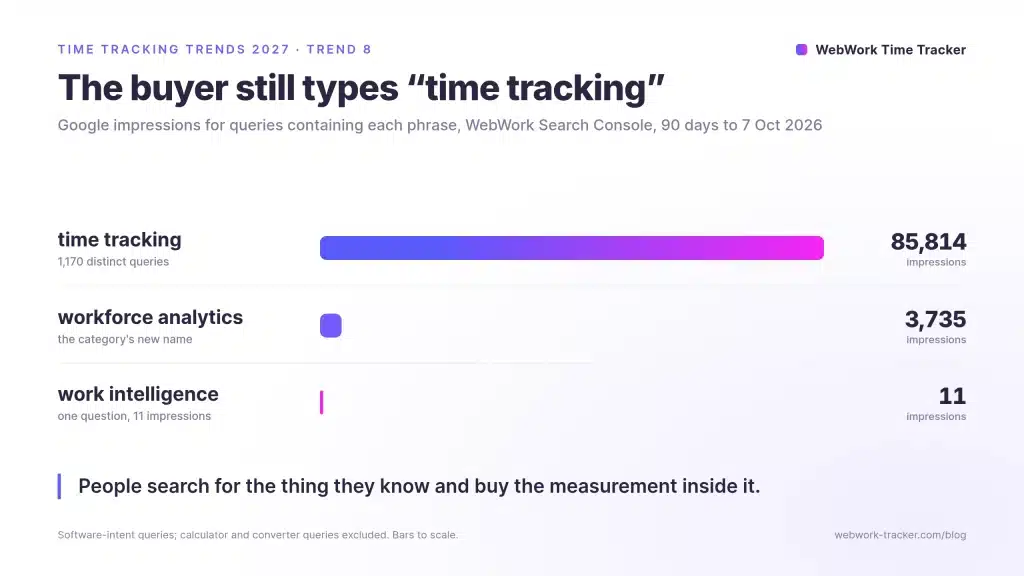
That is why the product is still called WebWork Time Tracker, from $3.99 per user per month, and why the KPIs, the job-title benchmarks and the AI reports ship inside it, from the Plus plan up, rather than as a separate analytics product. The category’s new names describe the output. The search box describes the input. Of all the time tracking trends on this list, this is the one I would bet the company on: in 2027 the winning product is honest about both.
What to buy in 2027
Put the eight time tracking trends together and the shopping list for 2027 is short. Measurement at the level of the work, with a target per role. A working-time record that survives an inspection. AI use as a tracked category of time. Location as a fact. A visibility setting the team can see and the lawyer can defend. All of it on top of ordinary time tracking, because that is where the data comes from.
Dubai needed six years to go from a pilot to a standard. A company of fifty people needs an afternoon.
Put the 2027 trends to work before January
WebWork Time Tracker brings time tracking, attendance, productivity KPIs and AI reports into one system. Plans start at $3.99 per user per month; KPIs and benchmarks come with Plus, from $6.39. Book a demo for a guided walkthrough, or start a free trial and see your first report today.